

How To Repair Wood Grain In 1997 Toyota 4runner
Toyota 4Runner 3rd Generation (1996-2002) Buyer's Guide
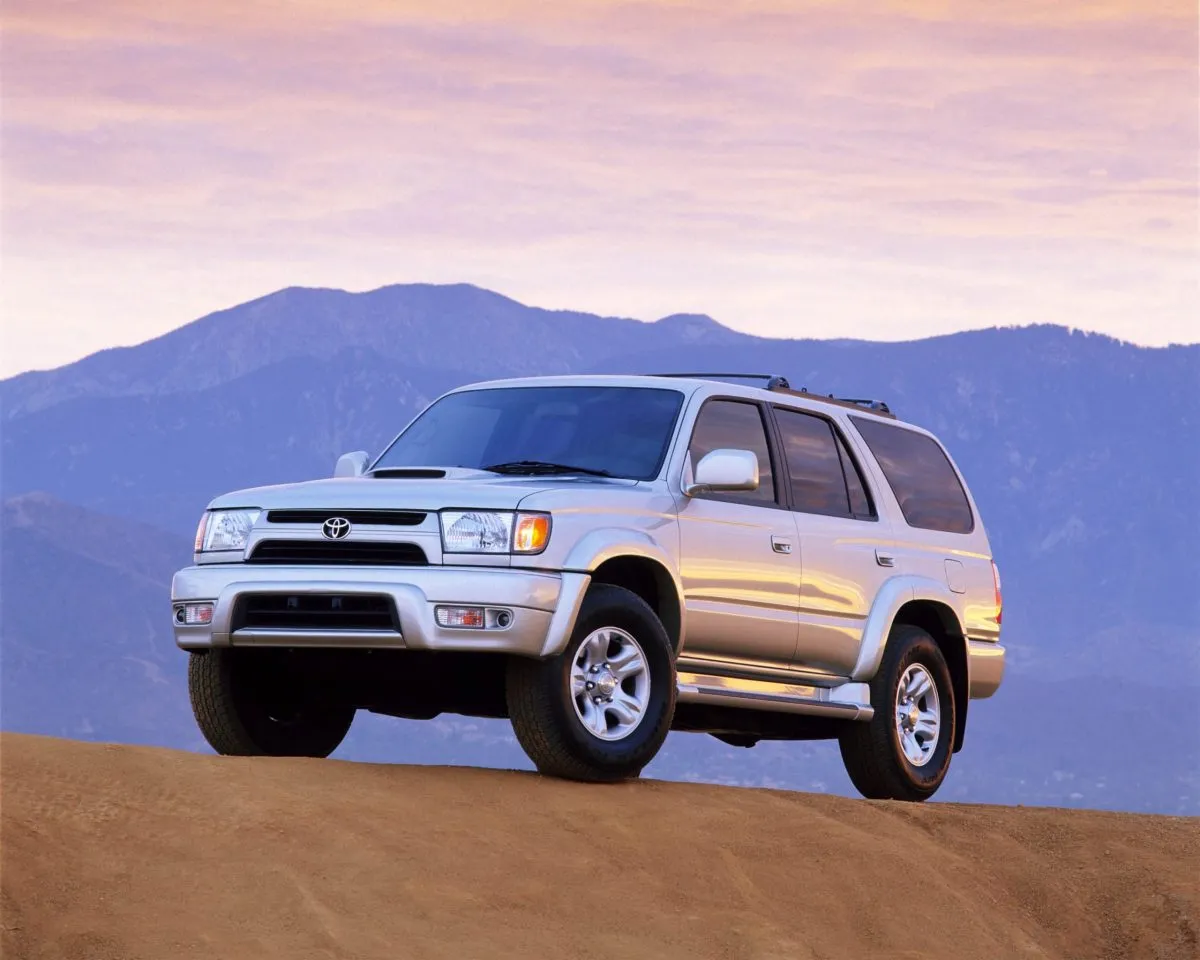
The Toyota 4Runner is a legendary rig. One of the last SUVs notwithstanding made with rugged body-on-frame construction, it pairs off-road prowess with Toyota reliability and longevity. Indeed, iSeeCars ranked it equally the longest-lasting midsize SUV in a recent study. As a result, it remains non merely a top seller at dealerships, but used 4Runners also command significant need and thus tend to retain their values surprisingly well.
Though now an icon, the 4Runner tin can trace its roots back to a unproblematic aftermarket conversion done by Winnebago, chosen the Toyota Trekker. It was basically just Toyota's popular Hilux pickup with two rear seats plus a fiberglass roof added over the bed.

Despite its apprehensive origins, the Trekker sold well plenty to convince Toyota to formalize the concept into the original 4Runner, which debuted in 1984.
Toyota has made substantial improvements to the 4Runner since and then, and many consider the 3rd generation of the model, sold from 1996 through 2002, a high indicate for both utility and design. Only with virtually 3rd gen examples now having spent more than 20 years on (and off) the route, information technology tin be tough to find a nice one to buy. They're nonetheless out in that location, if you know how to look. Then, to help you in your search, we've put together this comprehensive 3rd gen 4Runner ownership guide.
3rd Gen Toyota 4Runner Overview
By the time the tertiary generation of the 4Runner was launched for the 1996 model twelvemonth, the SUV that began life equally a slightly modified truck was now its ain fully-realized model. It all the same shared many components with its stablemate, the Tacoma pickup — most notably nether the hood — only its body and chassis were now unique to the model. Overseen by design chief Masaaki Ishiko, its simple lines are still handsome today, borrowing heavily from its meridian-of-the-line sibling, the Land Cruiser.
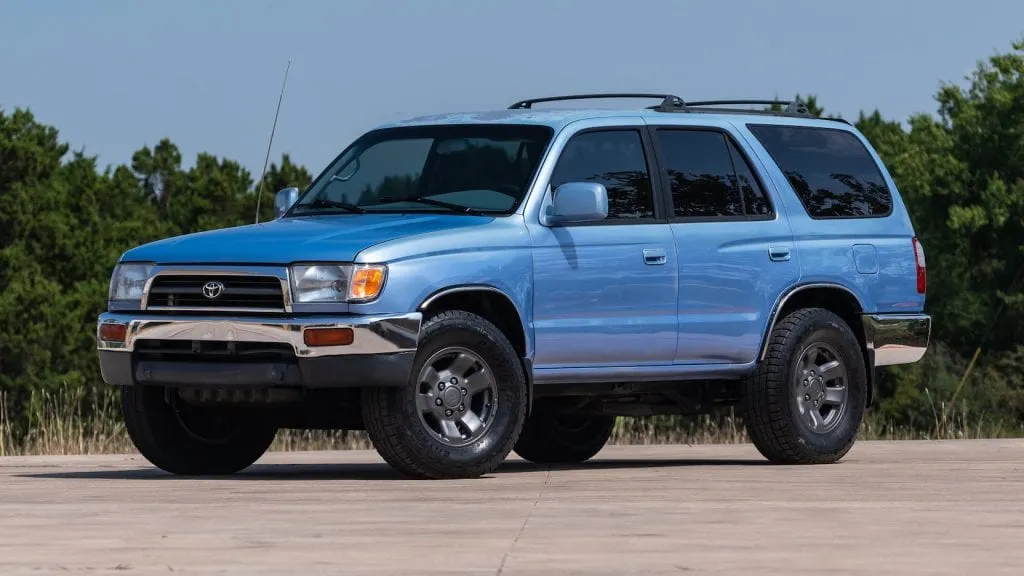
Compared to the outgoing 2nd gen 4Runner, the 3rd gen was longer, roomier, and safer, with dual front airbags plus ABS brakes available on all trim levels. It was also more powerful, efficient, and refined, thanks in large part to all-new engines, which were shared with the Tacoma and T100 trucks. Buyers had the choice of a standard 150 hp 2.vii liter iv cylinder (3RZ-FE) or an optional 183 hp 3.4 liter V6 (5VZ-FE), as well as either rear- or four-bike drive. About were backed by a four-speed automatic gearbox, though a 5-speed manual was available on some trims until 2000.
Engineers gave the third gen 4runner a new interruption, as well, employing double-wishbones upwardly front to enable a lower cabin flooring too as more interruption travel. They tossed the outgoing model's recirculating-ball steering in favor of a more than precise-feeling rack-and-pinion setup. These upgrades brand the 3rd gen 4Runner far more refined on the road, without compromising any of its off-road prowess.
The 4Runner was initially offered in iii different trims: base, SR5, and Express. The SR5 offered upgrades like chrome bumpers, color-keyed mirrors, power windows and door locks, a rear-window defogger, and intermittent wipers. Opting for the Limited version got you lot fifty-fifty fancier stuff similar leather seats, wood trim, a moon roof, as well every bit distinctive body cladding, fender flares, and running boards, plus larger brakes, wheels, and tires. On the flip side, the Limited trim was *not* bachelor with a 5-speed transmission gearbox, simply the 4-speed automatic.
Toyota 4Runner Model Year Changes
Afterward its 1996 debut, the tertiary gen 4Runner underwent minor changes in 1997 and 1998, including calculation a cargo comprehend in back and swapping the original 2-spoke steering wheel for a new 4-spoke blueprint.
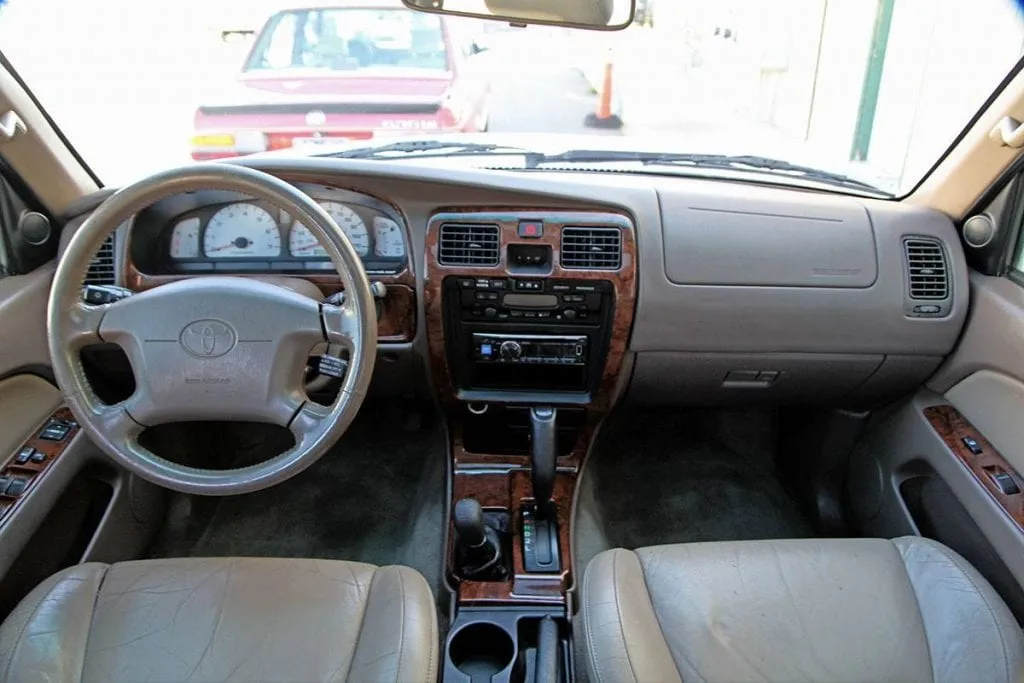
More meaning changes came in 1999, including an extended "fat lip" forepart bumper (for added collision protection), a mild redesign of the interior controls, and a new musical instrument console with a digital odometer. Toyota likewise introduced a new mid-level trim, dubbed Highlander (and later renamed Sport). It paired some of the desirable features from the Limited trim, like larger wheels and brakes and the body cladding, without sacrificing the manual gearbox option.
Also in 1999, Toyota introduced a new "multi-way" four-wheel drive arrangement on the Limited trim. The new setup employed a center differential, allowing the vehicle to deliver ability to all iv wheels both on- and off-route. This is a pregnant advantage for those who live in moisture or wintery climates, where encountering slippery pavement is not uncommon. (Without it, you would typically engage 4WD only when driving off-road.)
The 2001 model year brought the last major 4Runner changes. Most notably, a number of feature were dropped, including the four cylinder engine and the manual gearbox, leaving just the V6 and the 4-speed automatic standard across all trims. Likewise cut was the optional electronic-locking rear differential. This was a popular option for serious off-roaders because information technology facilitated maximum traction in extreme conditions.
In its identify, Toyota added electronic traction and stability control systems (known as TRAC and VSC, respectively) in 2001. These are handy safety features in normal driving; nevertheless, we should note that they lack the sophistication of more modern traction control systems so they tin can be triggered in error during off-road exploits. On the plus side, Toyota now offered multi-way four-bicycle drive on all trim levels, where information technology remained through 2002, the last 3rd gen model year.
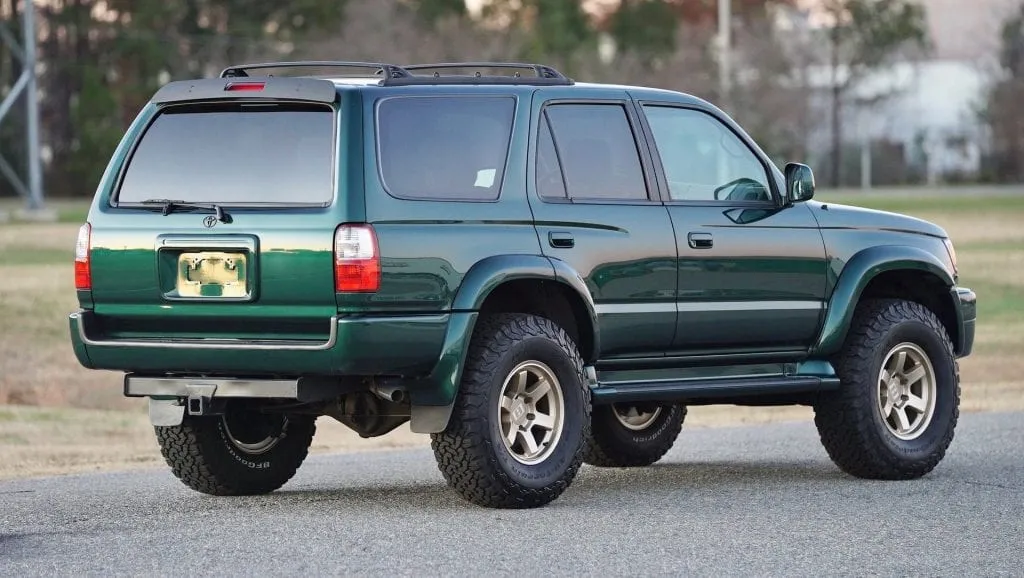
All-time Toyota 4Runner Years and Trims
Start and foremost, we recommend looking for a used 4Runner with both four-wheel drive and the V6 engine. That combination is going to cyberspace y'all the virtually blindside for your buck. No disrespect to Toyota's venerable 3RZ-Atomic number 26 iv cylinder, simply you really need the additional power of the V6 to operate a xx+ year old 4Runner in modern traffic. Beyond that, which 4Runner you buy should exist based primarily on its status and how y'all plan to use information technology.
If you're looking for the virtually capable off-roader, you'll desire to stick with the pre-2001 years, which offer an e-locking rear differential as well a manual gearbox. Most desirable of all would be a 1999 or 2000 in Highlander trim with those options, plus the boosted upgrades over the SR5. Or if you'd prefer an automatic, you lot could opt for a 1999 or 2000 in Express trim, which gains you lot the desirable multi-mode four-wheel drive organisation.

On the other hand, if yous simply want a nice old rig that'south capable of doing occasional trail duty, we'd suggest holding out for a 2001-2002 4Runner in Sport or Express trim. Though these lack some of the hard-core off-road options noted to a higher place, they take all of the improvements that Toyota fabricated through the 3rd gen 4Runner'south production run. Plus they look the part with their larger wheels and added running boards, fender flares, fog lights, and roof rack. The Limited trim fifty-fifty offers modern civilities similar heated seats and automatic climate command.
Every bit with whatsoever older used car, you'll also want to buy the very all-time example you can detect within your upkeep. These SUVs are well made and can last well over 200,000 miles with proper intendance, and so your number 1 business concern should be finding ane that has a well-documented history of expert service.
The market place for squeamish 3rd gen 4Runners is strong, so you may be tempted to compromise your standards and purchase one of the cheaper ones out there. Just please annotation that the cost of reconditioning a needy 4Runner will far exceed its value, especially if y'all aren't doing the work yourself. It's almost always more cost effective in the end to pay a bit more upfront for a well-kept specimen.
Used Toyota 4Runner Problem Areas
In one case y'all're ready to start examining specific 4Runners for auction, there are a number of common problem areas that y'all should wait out for.
Rust
The foremost 4Runner problem area is rust. Fortunately, it's relatively like shooting fish in a barrel to spot rust on a 4Runner. Just climb underneath it and await up. If yous run across anything more than than minor surface corrosion on the frame and chassis, we recommend walking away. Unless you're handy with metalworking, information technology's but as well much trouble to bring a rusty 4Runner back to good wellness.

Before you even climb underneath, though, you lot can eliminate most rust issues past shopping only for 4Runners that accept lived their lives in areas which don't salt the roads during winter. That includes most of the South and Southwest as well equally the Pacific Northwest. A quick check of the vehicle'due south Carfax or Autocheck history report tin can commonly confirm this.
Automatic Transmissions
The 4-speed automated gearbox in 4Runners can suffer from a condition known every bit "strawberry milkshake." That's when corrosion in the radiator allows engine coolant to mix with automatic transmission fluid (which is cooled in the lower part of the radiator), turning it into a frothy pink liquid. This first shows up in the coolant overflow reservoir — and if left unchecked volition quickly make its way into the transmission, often resulting in catastrophic failure.
Nigh likely, the examples you're looking at won't have this outcome, just it's a good thought to study the service records to see if it has happened in the vehicle'due south by. Await for a history of the radiator being replaced along with a flush of the transmission fluid. That's a bad sign. It could mean that at that place is residual transmission damage which could cause yous bug down the line.
To preclude this, virtually 4Runner owners are vigilant about irresolute their coolant at regular intervals, and some volition preventatively supercede the radiator every 8 years or so, at a cost of virtually $150 plus installation. That'southward a pocket-sized price to pay to ensure the long-term health of your automatic transmission.
Brakes
The OEM brake rotors on 3rd gen 4Runners are notoriously thin, which makes them decumbent to warping during hard braking. If the rotors are warped, you'll notice it quite easily on a examination drive. Once you lot're up to speed, press lightly on the restriction pedal. If you lot feel whatsoever pulsing nether your foot, the rotors are warped. In extreme cases, warping can cause the whole vehicle to shudder when braking.
Fortunately, the set for warped rotors is pretty easy. Just swap in new ones. Merely since the original pattern is non quite robust enough, warping is likely to render. Fifty-fifty meliorate is to upgrade the rotors, calipers, and pads to those from a first generation Toyota Tundra (2000-2006), which are far more than substantial. Parts for the upgrade are near $300, which is worth the investment to ensure longer-lasting rotors.
Pause
In 2005, Toyota issued a retrieve for some third gen 4Runners for a problem with the lower brawl joints, which in extreme cases could result in a front wheel falling off the vehicle. By now, most examples will have had this trouble addressed, merely information technology's worth checking if the specific 4Runner y'all're looking at has had them replaced under the recollect. If it isn't apparent from the service records, a quick telephone call to your local Toyota dealer should be able to articulate this up.
You tin also look for signs of lower ball joint bug on your test drive. Mind for odd noises coming from the front suspension when traveling over bumps and potholes, and test for play or roughness in the steering. These are signs that one or more of the pause components needs replacing.
A 3rd gen 4Runner can likewise endure from sagging rear springs, which should exist obvious from its appearance. The fix for this is pretty straightforward: just supervene upon the springs with new ones. Many owners choose to install springs specced for the 1999 SR5 iv×4 V6 model, which are known to be the tallest.
Timing Belts and Fluids
Toyota's 5VZ-Fe V6 engine employs a timing belt, which must be inverse every xc,000 miles. Typically the h2o pump is also replaced at this time. You'll want to make certain this piece of work has been done on time for whatever vehicle you're because. If not, gene in a cost of nearly $700 for this work at the dealer.

Likewise, y'all'll want to ensure that whatsoever 4Runner that you lot're evaluating has had its critical fluids changed on a routine basis. That includes not only the engine oil and filter (at to the lowest degree every 5000 miles) but also the differential fluid and coolant (every 30k miles) and the transmission fluid (every 40k miles).
Used Toyota 4Runner Prices
The third generation is one of the most sought-after iterations of the 4Runner. As a upshot, prices for nice examples might surprise you. Low-mile, pristine examples are selling on Bring a Trailer for $xx,000 or more, including a contempo 5k mile outset-year SR5, which probable set up some records when it airtight at $43,000.
Simply unless y'all're looking for a collector'southward item (or just have some serious money to burn), you don't really need to spend that much. We'd target $10-15k for a well-kept V6 4×4 instance with around 150,000 miles, depending on the trim and features. Keep in listen that vehicles with somewhat rare option combinations, like a 5-speed manual gearbox with the eastward-locking rear differential, will command a premium.
Yous can definitely detect solid 4Runners for sale for less than $10,000. Notwithstanding, they volition probable have 200,000 miles or more and may exist lacking some desirable equipment, like iv-wheel drive or the V6 engine. Additionally, they may have cosmetic issues, like faded paint and worn interiors. Worse, they may accept problems like an blow history, rust, or deferred maintenance. We suggest treading carefully if the price seems a little too good to be true.

The Lesser Line
Toyota has developed ii fully new generations of the 4Runner since the last of the 3rd gen models were sold. Both the 4th and 5th gen 4Runners are besides great SUVs, with notable improvements over their replacements. However, there'due south something about the 3rd gen 4Runner that simply never gets old. Perhaps it's the rugged good looks. Or its only-right size. Or the fact that it comes from what many consider the peak years of Toyota quality and blueprint. In any instance, it'southward in a sweetness spot between the more rudimentary early version of model and the larger, more complex automobile that it has since go.
We look squeamish 4Runner examples from this generation will continue to delight their owners for many years to come. And with prices as low every bit they'll ever be, now is an excellent time to buy 1.
Photos courtesy Mecum, Toyota, and Wikimedia Eatables
Related Posts

Source: https://www.klipnik.com/best-used-cars/toyota-4runner-3rd-generation-1996-2002-buyers-guide/
Posted by: comptoncorant85.blogspot.com
0 Response to "How To Repair Wood Grain In 1997 Toyota 4runner"
Post a Comment